Weaving Fabulations, 2025
Weaving Fabulations was a five-day workshop in Taiwan in which students from NYCU and NTHU built imagined worlds through stories, scenario cards and physical artifacts. Developed by Chris Woebken Studio with Scenario Lab, Der-Jang Yu and Taotao Yu, the workshop drew on Donna Haraway’s fabulation and Ursula K. Le Guin’s Carrier Bag Theory of Fiction to explore mutualism, repair and living on a damaged planet. Student proposals included a memory orchard and organisms imagined as tools for environmental cleanup.
Research interests
Participatory futures · Speculative futures · Prototyping
Workshop context
Five-day intensive · Free program · Taiwan
Students from NYCU and NTHU
Chris Woebken Studio with Scenario Lab
Developed with Der-Jang Yu and Taotao Yu
Documentation & videography: Karan Lo


2025 · Documentation and videography: Karan Lo · Full photo album
Workshop process
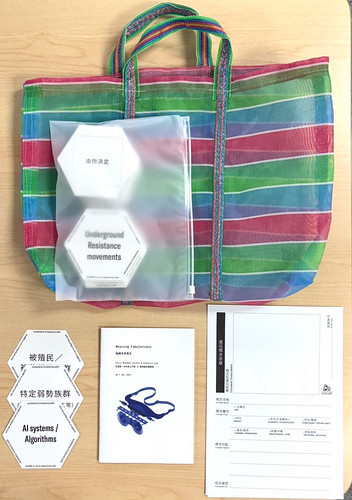
Throughout the week, participants worked with a custom Design Kit provided by the organizers, which included a zine booklet, concept scaffolding cards, and a classic Taiwanese tote bag. Groups engaged in deep, collaborative world-building, moving from initial concept storming to sketching and model-making. They created physical artifacts meant to serve as evidence of these imagined worlds.
The curriculum drew from two foundational texts. Donna Haraway's concept of "fabulation" - telling stories that allow us to stay with the trouble and live well on a damaged planet - provided an ethical orientation. Ursula K. Le Guin's "Carrier Bag Theory of Fiction" offered a structural framework. Where conventional storytelling often centers on a singular hero wielding a powerful tool, Le Guin proposes that the earliest and most comprehensive human technology was actually a receptacle: a bag for gathering.
Applied to design, this philosophy means viewing stories and objects not as linear solutions, but as containers capable of weaving together complex, interconnected ideas. The workshop urged students to use design as a provocation, shifting away from affirmative, consumer-driven production and toward critical thinking about how the world could look with a stronger emphasis on mutualism, plurality, repair, and impermanence.
Rather than following rigid corporate design methodologies, the workshop used an Eastern narrative framework - Qi (Introduction), Cheng (Elucidation), Zhuan (Transition), and He (Conclusion) - to guide the arc of each project. A "yes, and" mindset encouraged students to build fluidly on one another's ideas, generating intricate, co-authored fabulations.
Student concepts
The resulting prototypes were provocative and highly imaginative, addressing complex challenges. A selection of concepts created during the week:

The Memory Orchard
Anticipating a future of severe human overpopulation and ecological biodiversity loss, one group designed a system to preserve knowledge. They created a physical "orchard" where trees act as access points. In their scenario, touching a tree allows users to enter a virtual environment to experience memories and find a space for mourning.

Bio-Computing Pollution Cleaners
Another team tackled the threat of extreme, unlivable environmental degradation. They proposed a future where major corporations and biotech firms develop hybrid organisms to handle the crisis. Their concept featured biologically altered rats functioning as organic computers, capable of rapidly calculating cleanup strategies and utilizing symbiotic microorganisms to digest targeted pollutants.
Reflections
The ultimate goal of "Weaving Fabulations" was not to produce market-ready products, but to exercise new conceptual muscles. By stepping outside the tight constraints of industry feasibility, the students practiced visualizing scenarios of entirely new worlds.
As the week concluded, participants noted how the experience broke their preconceived notions that design must always serve a strictly utilitarian purpose. They walked away with a broader, more flexible approach to their practice, equipped with the imaginative tools needed to question, navigate, and shape complex issues.
Credits & acknowledgements
Developed in collaboration with Der-Jang Yu and Taotao Yu. A warm thank you for the invitation and support throughout the week. Special thanks to the students at NYCU and NTHU, and to Karan Lo for documentation and videography.
