Making Kin with Biomaterials
Exploring relationships with microorganisms through grown materials, biological prototypes, and scenarios for a post-carbon society.
← Back to TeachingFall 2022
Selected student projects
Birdhouse
Student project by Daniel Vanderhorst · Fall 2022
Material and habitat studies
Material and habitat studies asking whether natural ingredients and natural processes can support habitats for animals.
Can we use natural ingredients and natural processes to make better habitats for animals?


Lampshade Design
Student project by Eujin Kim · Fall 2022
Silkworm material and prototype studies
An experiment in cohabitation and making with silkworms. Eujin Kim gathered mulberry leaves from New York streets to feed the worms, then varied light and shade around a scaffold to guide silk deposition into a lampshade.


Course process · Fall 2022


Fall 2021
Selected student projects
Biobased data center
Student project by Adeline Chum, Jules Kleitman, Aditi Mangesh Shetye · Fall 2021
Precognitioning post-oil · Scenario development
A post-petroleum scenario imagines an existing IBM data center becoming a forest where tree rings store data and mycorrhizal networks connect it.
In a post-petro future, we imagine a biobased data center made up of a forest. Forest trunk rings will store our data and be wired through mycorrhizal networks underground. Each person will be given their own tree and as the tree grows, so can their data storage. This forest and mycelium growing center will be superimposed on the existing degrading IBM data center.

Course process · Fall 2021
Course outline
The realm of the tiny and invisible has actively been ignored within modern societies, despite or exactly because modern science found out more and more about our mutual relations and dependencies with microorganisms, fungi, and other non-human species. Only recently, this situation has started to change. New scientific, computational, philosophical, and evolutionary approaches emphasize the decisive role of the microbiome in the development and maintenance of complex life-forms. In the pyramid of organic life, microorganisms not only lay the foundation but by far represent the largest part, both in numbers and in volume or weight.
With the dawning of the carbon-based period of modernity and the realization of the environmental costs that are going along with it, biological agents and materials have received a major upgrade in public recognition. Being it for substitution of carbon-based building materials or fuels, being it as a means to clean up the petromodern mess, or being it as the basis for entirely new regimes of nutrition, transport, and living, nowadays’ future scenarios are full of visions for newly envisioned uses of or, rather, collaborations with microorganisms.
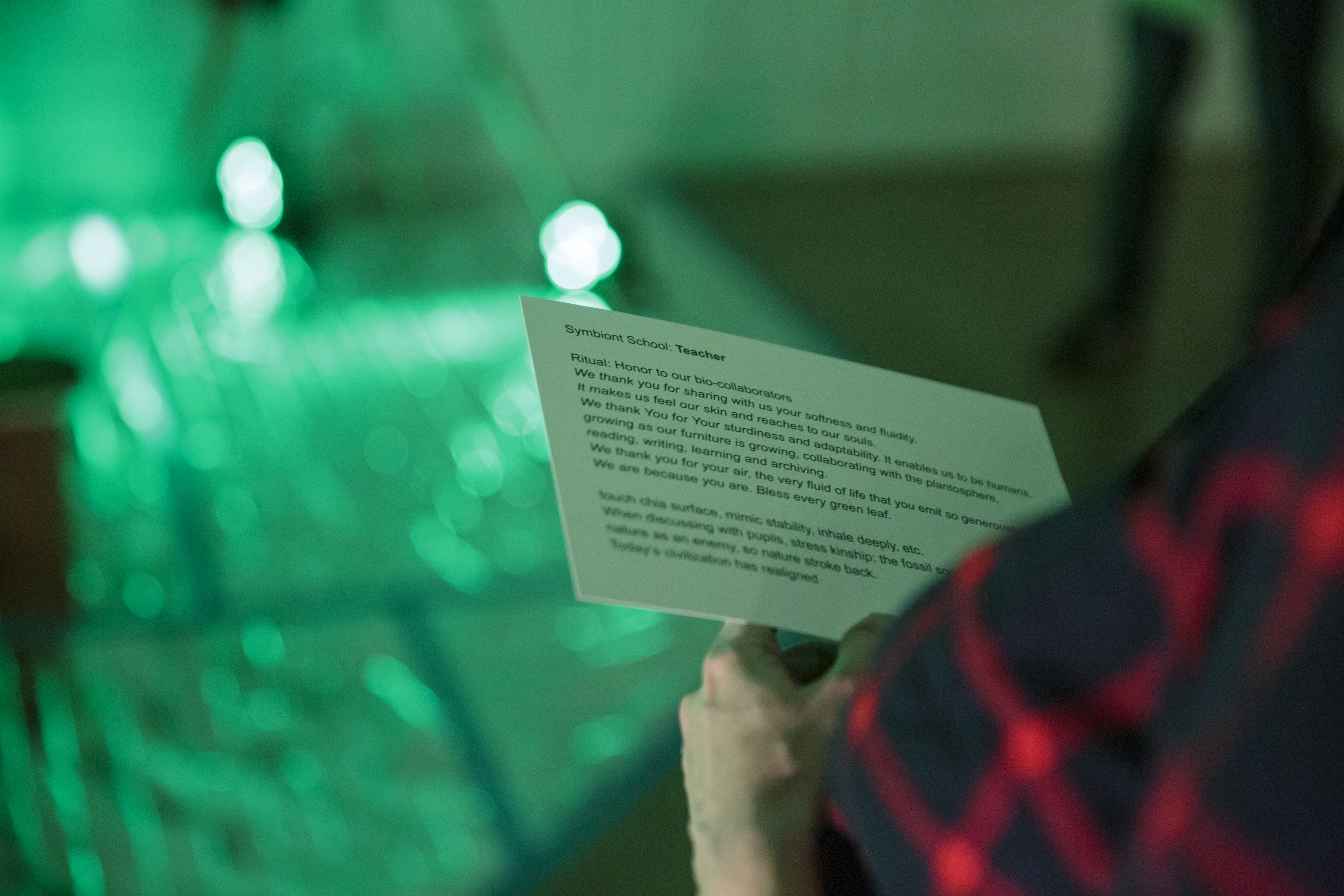
This course aims to theoretically and practically investigate and reveal these mutual relationships and multispecies collaborations across all scales. Students will interrogate different approaches of industrial production, conceptualize and materialize objects that propose alternative approaches and situate these artifacts within the speculative frameworks and future developments. We will be designing prototypes for interfacing with biological systems in the form of grown materials, bioreactors, sampling instruments, or bio-receptive substrates. Students will have the chance to present work-in-progress prototypes and scenarios in a public forum at our partner and project space 1014 within the framework of a series of workshops to embody and imagine life in a post-carbon society.
Goals
- Investigate mutual relationships and multispecies collaborations across scales.
- Develop physical prototypes for interfacing with biological systems.
- Situate material experiments within speculative frameworks and future developments.
Connected program
Precognitioning post-oil, 2021 — public sessions at 1014 connecting the course to embodied exploration of life after fossil fuels. Developed with cultural researcher Alexander Klose.