Commissioned by Deep Science Ventures
Deep Science Ventures (DSV) is redefining how deep tech companies are born through their distinctive "scoping" methodology. Unlike traditional "tech push" approaches that start with a technology seeking a unique opportunity space, DSV's process begins with a clear societal outcome and works backward. Their founders first define the change they want to create, then thoroughly explore the problem space from multiple angles before identifying the optimal technological solution.
When DSV launched their innovative Venture Science Doctorate program—designed to teach PhD candidates how to transform their research into impactful companies—they partnered with The Extrapolation Factory to bring their curriculum to life. Our challenge was to create six immersive, playful experiences that would introduce candidates to each phase of DSV's rigorous scoping methodology.
By applying a design futures lens to DSV's proven approach, we translated their company-building framework into an engaging educational journey. Each experience was carefully crafted to help doctoral candidates understand and internalize the principles that make DSV's methodology so effective at creating meaningful technological breakthroughs.
One of these experiences is Future Gazing, a collaborative virtual game where participants work together to dream up a successful venture in a future scenario. It is an exercise designed to help players work backwards from a desired objective, see the many pathways possible to get there, as well as the many factors that play a part in determining a pathway. The game acts as a way of introducing futuring concepts such as the STEEP model, backcasting, inflection points, and the 2x2 scenario matrix.
![]()
For Future Gazing, all players choose one predefined problem area (such as “reduce Earth’s temperature by 1.5 C by 2050) and then each team works through the board to come up with a possible pathway to address this problem. Using techniques such as Madlibs style prompts, collaging, and combinatory play, each team create scenarios in which a speculative venture of their design has been successful at achieving this outcome. In the final part of the game, each team has 1 minute to pitch their speculative venture idea to the facilitator, who chooses a winner based on creativity, completeness, and scale of impact.
![]()
![]()
When DSV launched their innovative Venture Science Doctorate program—designed to teach PhD candidates how to transform their research into impactful companies—they partnered with The Extrapolation Factory to bring their curriculum to life. Our challenge was to create six immersive, playful experiences that would introduce candidates to each phase of DSV's rigorous scoping methodology.
By applying a design futures lens to DSV's proven approach, we translated their company-building framework into an engaging educational journey. Each experience was carefully crafted to help doctoral candidates understand and internalize the principles that make DSV's methodology so effective at creating meaningful technological breakthroughs.
One of these experiences is Future Gazing, a collaborative virtual game where participants work together to dream up a successful venture in a future scenario. It is an exercise designed to help players work backwards from a desired objective, see the many pathways possible to get there, as well as the many factors that play a part in determining a pathway. The game acts as a way of introducing futuring concepts such as the STEEP model, backcasting, inflection points, and the 2x2 scenario matrix.
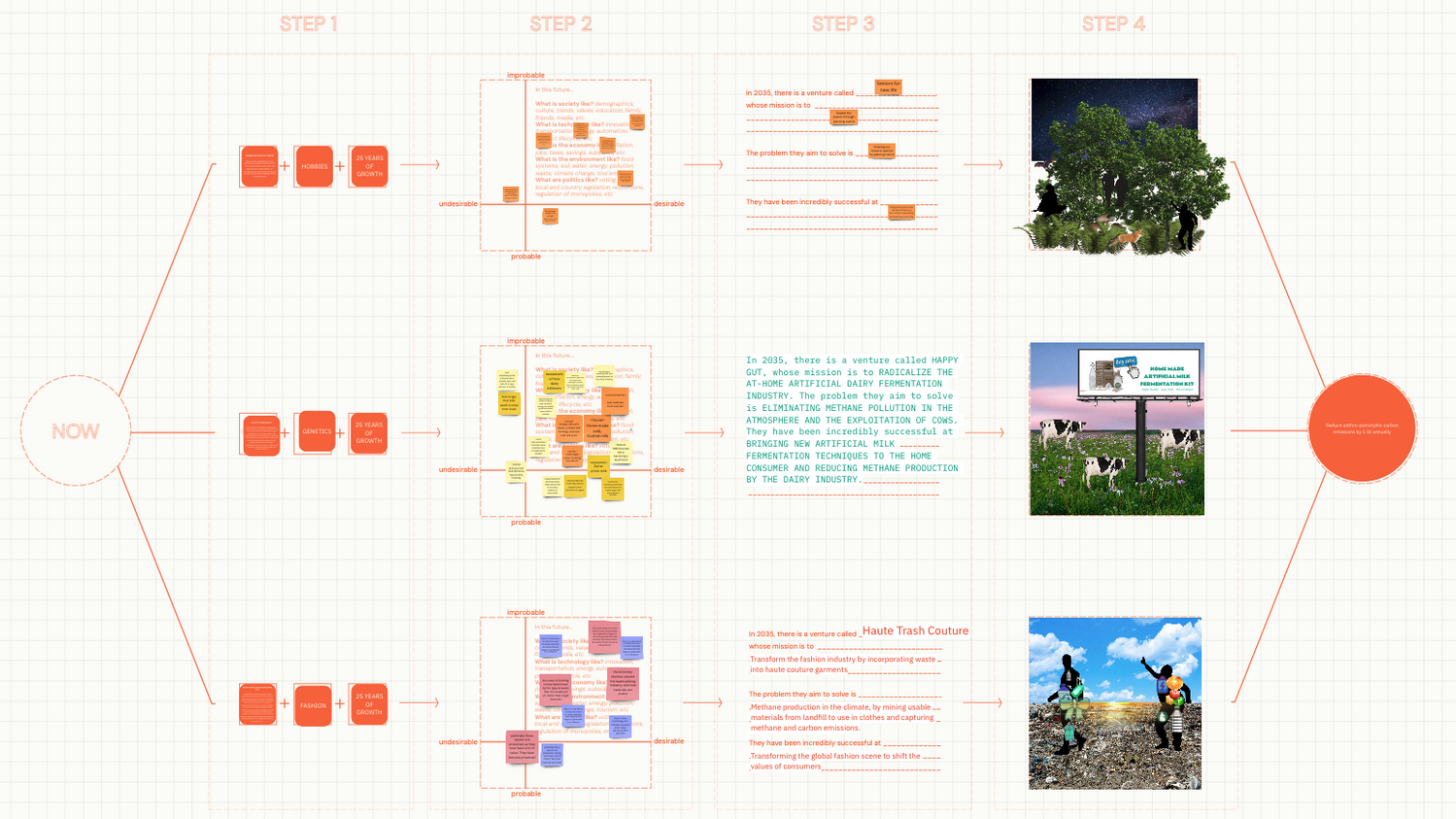
For Future Gazing, all players choose one predefined problem area (such as “reduce Earth’s temperature by 1.5 C by 2050) and then each team works through the board to come up with a possible pathway to address this problem. Using techniques such as Madlibs style prompts, collaging, and combinatory play, each team create scenarios in which a speculative venture of their design has been successful at achieving this outcome. In the final part of the game, each team has 1 minute to pitch their speculative venture idea to the facilitator, who chooses a winner based on creativity, completeness, and scale of impact.


Team:
Extrapolation Factory (Chris Woebken, Saralee Sittigaroon, Grace Mervin)
Deep Science Ventures (Aaron Appleton, Eirini Malliaraki)
Extrapolation Factory (Chris Woebken, Saralee Sittigaroon, Grace Mervin)
Deep Science Ventures (Aaron Appleton, Eirini Malliaraki)
